Category: History
Note: This article is based on my own research and may contain errors. Please treat it as general background knowledge.
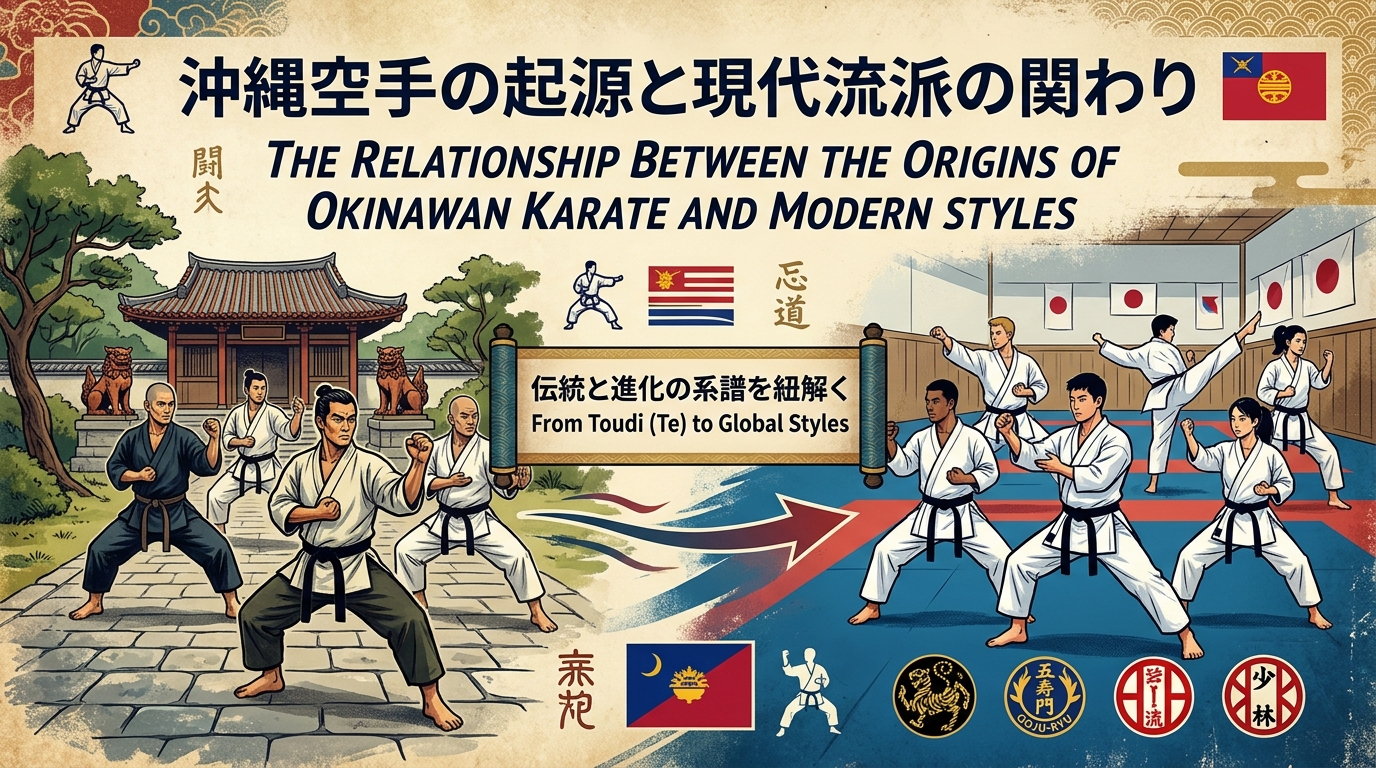
The “Original Schools”: Okinawan Karate and Its Classical Lineages
Before the modern era, karate was usually described not by registered style names like “○○-ryu,” but by region (Shuri, Naha, Tomari) and teacher-to-student lineage.
- Shuri-te: The martial culture around the royal castle. Said to emphasize quick, linear attack and defense.
- Naha-te: Developed in the port town, a hub of cultural exchange. Said to emphasize close-range fighting, breathing, core strength, and sparring-like elements.
- Tomari-te: Considered a middle ground or blend of the two, though historical interpretation is still debated.
On top of these regional traditions came the lineages of individual masters (for example, the Matsumura line, the Itosu Anko line, the Miyagi Chojun line, and the Motobu Choki line), which were later organized into the “○○-ryu” styles we know today.
Whether karate can be neatly divided into these three “-te” varies among researchers and styles.
The “Modern Styles”: Names Established from the 20th Century
From the Taisho to the Showa era, karate spread from Okinawa to mainland Japan. In the process it was taught in schools, organized into associations, and came to be called “○○-ryu.”
Representative Styles Originating in Okinawa
- Goju-ryu: Said to have strong Naha-te characteristics, with an emphasis on kata, breathing, and close-range work.
- Uechi-ryu: Regarded as a distinctive close-range system.
- Shorin-ryu, Matsubayashi-ryu, and Shito-ryu (Okinawa): Styles systematized on the Okinawan side.
The “Big Four” and Other Styles That Spread Across the Mainland
- Shotokan-ryu: A leading example of Okinawan karate systematized on the mainland and developed toward competition.
- Goju-ryu: Also has many large organizations on the mainland.
- Shito-ryu: Strongly characterized by integrating several lineages.
- Wado-ryu: Reconstructed by a practitioner with a judo background, and often described as combining karate with judo body mechanics.
What Changed from the Original Schools to Modern Styles
- Names and organization: From individual lineages to style names, branches, and rank systems.
- Purpose: From self-defense and physical training to school physical education, tournaments (kata and kumite), and international expansion.
- How techniques appear: Close-range, grabbing, and practical elements are emphasized or downplayed depending on competition rules and teaching policy.
Common Misunderstandings
- The original karate was not “just three -te.” It is a blend of teacher lineages, kata genealogies, and regional culture.
- Modern styles did not simply replace the old. Many retain old kata and principles, while teaching methods, competition, and safety practices have changed.
The Limits of a “Worldwide Family Tree”
Karate cannot be drawn as a single family tree, mainly for three reasons:
- Simultaneous branching: There have been many splits and independent organizations.
- Composite origins: New names are often created by mixing elements from several styles and teachers.
- Competition, trademarks, and politics: A style’s name does not always match what is actually taught.
So please read what follows as the main trunk lines along which karate spread worldwide.
The Main Lineage (Overview)
1) Okinawan Origins (Pre-modern to Early Modern)
Tode (唐手) / Te (手)
- Shuri-te
- Naha-te
- Tomari-te (classification debated)
On top of these regional lines, teacher-to-student transmission (who learned what from whom) gave rise to the later “○○-ryu” styles.
2) Major Styles Established in Okinawa
(Representative examples, in no particular order, not exhaustive.)
- Goju-ryu (strong Naha-te character)
- Uechi-ryu (a distinctive close-range system)
- Shorin-ryu and Matsubayashi-ryu, among others (often associated with Shuri-te lines)
- Shito-ryu (strongly integrative)
These styles then spread around the world through emigrants, military personnel, seminars, and immigrant communities.
Diagram: The Relationship Between the Origins of Okinawan Karate and Present-Day Styles
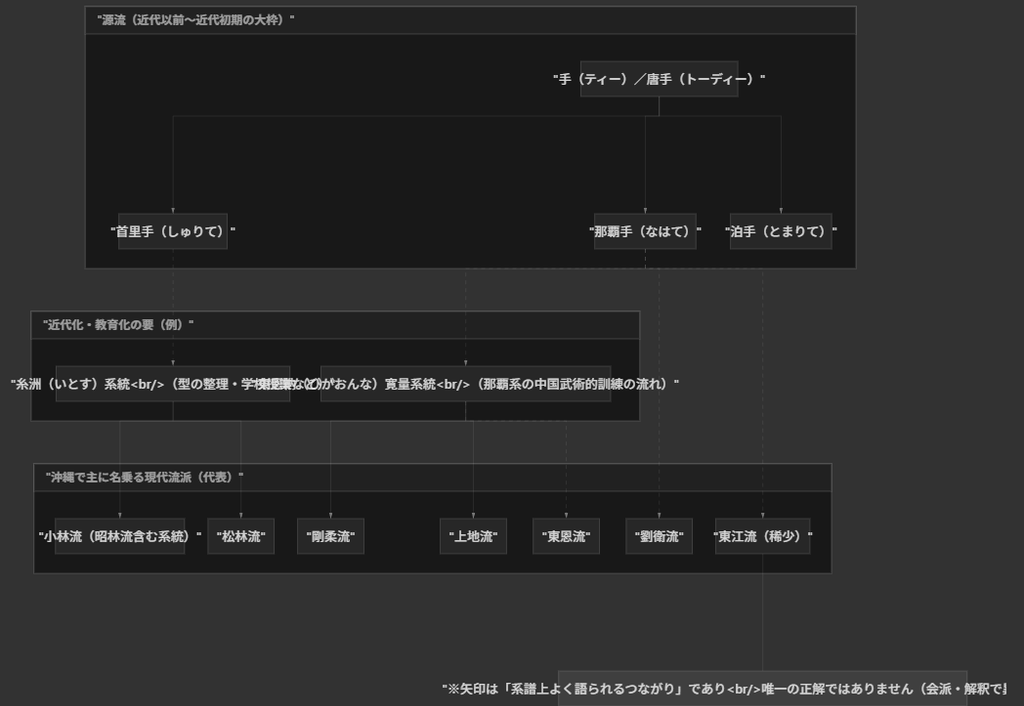
| Symbol | Meaning |
|---|---|
Solid line --> | Main lineages commonly cited in the histories of the styles |
Dotted line -.-> | Close relationship, influence, or shared origin, but a strict “direct line” is often disputed |
Relationships Left Out of the Diagram
- Shito-ryu: Largely integrated the Shuri and Naha lines on the mainland. In a diagram of Okinawan origins, it is usually placed separately, as a meeting point on the mainland side.
- Shotokan-ryu and Wado-ryu: Mainly reorganized and made independent on the mainland, so it is clearer to show them on a separate layer as “exports” from Okinawa.
So Where Does Shotokan Come From?
If I had to name one source, the answer most often given is the Shuri-te lineage, particularly the line of Itosu Anko.
To be a little more precise:
- Funakoshi Gichin mainly studied the Itosu line in Okinawa, a lineage in which kata had been organized and adapted for education.
- He is also said to have been influenced by traditions from the Shuri area, such as that of Azato Anko.
- After he taught and systematized karate on the mainland, the name “Shotokan” (his pen name “Shoto” plus “kan,” meaning hall) took hold as the name of the dojo and style.
Common Misunderstandings
- The names of today’s Okinawan Shorin-ryu styles, such as Shorin-ryu and Matsubayashi-ryu, do not correspond one-to-one with the karate Funakoshi practiced at the time.
- It is safer to see Shotokan not as “a direct line of Shuri-te itself,” but as a lineage that passed through the Shuri-te tradition and was reorganized on the mainland, with the Itosu line as its backbone.
In short, if forced to pick a single source, it would be Shuri-te, in the line of Itosu Anko.
3) The Mainland Hubs of Worldwide Expansion
These styles reorganized Okinawan karate for the mainland and educational use, and became starting points for global expansion:
- Shotokan-ryu: Very large in branches and number of practitioners worldwide.
- Goju-ryu: Many mainland organizations, with a wide reach overseas.
- Shito-ryu: Includes a wide variety of kata and lineages, and many organizations.
- Wado-ryu: Often described as a reconstruction based on judo-style body mechanics.
4) Systems Derived from Karate That Grew Large on Their Own
Strictly speaking, these are not all “direct lines of classical karate,” but are heavily composite, reorganized, or competition-oriented.
- Kyokushin-kai lineage: Generally described as a reorganization influenced by Goju-ryu and Shotokan, from which many Kyokushin and full-contact groups later emerged.
- Ashihara-kai lineage and others: Many independent groups formed around the Kyokushin lineage.
- Full-contact and kickboxing-style karate: The rules and goals changed, so names and lineages are hard to trace. For some, the line between “karate origin” and “a separate sport” is blurry.
5) Competition Karate (e.g., the WKF System)
In the context of world championships, competition federations come to the fore rather than styles. Behind them, Shotokan, Goju-ryu, Shito-ryu, and Wado-ryu backgrounds are usually mixed, since athletes and coaches come from diverse origins.
The Whole Picture in One Line
Okinawan Te (Shuri / Naha / Tomari + teacher lineages)
→ Major Okinawan styles (Goju, Uechi, Kobayashi/Matsubayashi, Shito…)
→ Reorganization and growth on the mainland (Shotokan, Goju, Shito, Wado…)
→ Spread to every continent via emigrants, the military, and seminars
→ Local splits, name changes, and separate competition rules (Kyokushin lineage, etc.)
Closing Thoughts
Some parts of this overview may not be accurate, but I wanted to get a rough picture of how karate’s origins relate to today’s styles. What I learned is that Shotokan, the style I practice, is not best described as “a direct line of Shuri-te itself.” It is a lineage that passed through the Shuri-te tradition and was reorganized on the mainland, with the Itosu line as its backbone.